
PRAHAAR: India’s First National Policy for Countering Terrorism
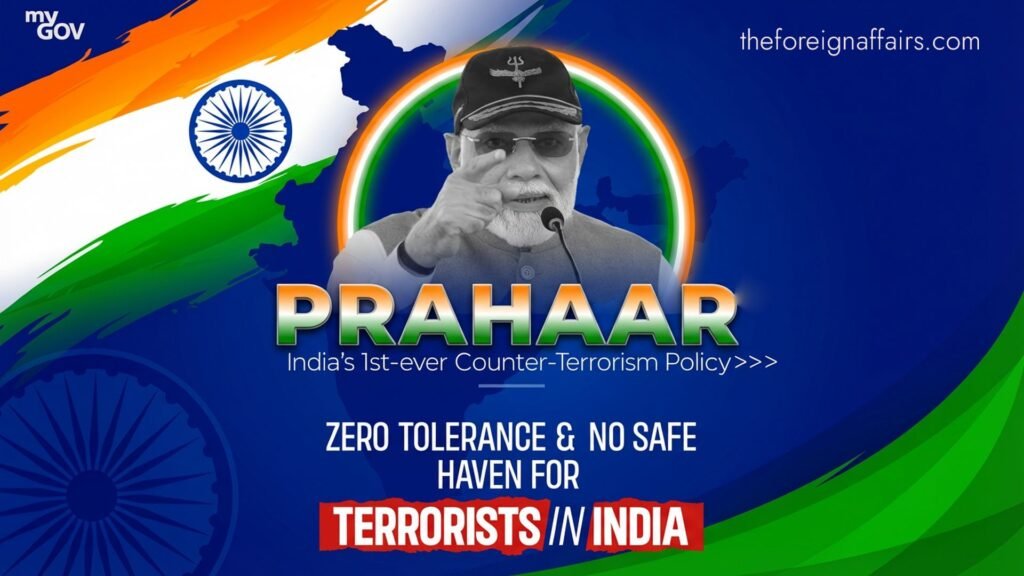
In a changing security landscape, India focuses on staying prepared and strengthening its response to emerging threats. The launch of ‘PRAHAAR’ marks a significant step toward building a modern security framework. This new system is designed to respond firmly and quickly to national threats.
Under the leadership of Prime Minister Narendra Modi, the guiding principle remains “Nation First.” The core focus continues to be strengthening security and safeguarding the people.
PRAHAAR operates on a strict “zero tolerance” principle. Its primary objective is to ensure no safe havens exist for terrorists within the country. The policy structures its approach around the PRAHAAR acronym. Each letter represents a core pillar of India’s unified national security strategy.
The 7 Pillars of the PRAHAAR Framework
1. P – Prevention
The first pillar focuses on stopping terror before it strikes. The policy shifts the approach from reactive responses to proactive security. Key measures include:
- Utilizing intelligence-driven surveillance.
- Focusing on early detection of threats.
- Neutralizing terror plots prior to execution.
- Protecting citizens, institutions, and national interests.
2. R – Response
When threats emerge, the policy mandates immediate action. The goal is to strike fast, smart, and together. This involves:
- Executing precision-led neutralization tactics.
- Ensuring seamless coordination across various security agencies.
- Deploying immediate countermeasures against active threats.
3. A – Aggregating
PRAHAAR establishes a “One Nation, One Security Grid.” This ensures collective strength against common threats. The aggregation pillar focuses on:
- Centralizing coordination for maximum operational impact.
- Facilitating seamless intelligence sharing across all agencies.
- Building a unified national security architecture.
4. H – Human Rights & Rule of Law
The policy commits to delivering justice without compromising legal standards. It mandates zero deviation from the law while maintaining zero tolerance for terror. This includes:
- Conducting strictly evidence-driven investigations rather than acting on impulse.
- Upholding constitutional values at every step of the process.
5. A – Attenuating Conditions for Terrorism
To cut the roots of terrorism, the policy aims to eliminate the conditions that breed extremism. Strategic actions include:
- Breaking radicalization networks at their source.
- Shutting down terrorist recruitment ecosystems.
- Dismantling propaganda machinery, both online and offline.
6. A – Aligning International Efforts
India aims to unite the world and isolate terror globally. This pillar focuses on strengthening multilateral intelligence cooperation. Global efforts include:
- Driving a worldwide consensus against terrorism in all its forms.
- Pushing for binding international legal frameworks.
- Countering cross-border terror financing and digital radicalization.
7. R – Recovery & Resilience
The final pillar ensures the nation recovers quickly from any incident. It reinforces the idea that no terror strike can break India. Focus areas are:
- Providing nation-wide support for victims and their families.
- Ensuring rapid rehabilitation for affected communities.
- Strengthening institutions to withstand future threats.
Conclusion: A Zero-Mercy Approach
The PRAHAAR policy establishes that every terrorist act is a severe crime against the nation. Under this framework, authorities will trace, freeze, and thoroughly dismantle terror funding. Furthermore, security forces will actively destroy weapons pipelines and safe havens. PRAHAAR marks a definitive, organized, and unyielding stance on national security.
Follow The Foreign Affairs on Google News and LinkedIn for credible analysis, expert insights, and in-depth reporting on geopolitics, diplomacy, global trade, economics, and world news. Stay informed with fact-driven perspectives and timely updates—only on The Foreign Affairs.